
US Peptide Science
Shop PeptidesArticles
ShopSearchCart

Stay Updated on New and Upcoming Products

Be the first to know about new peptides, research updates, and exclusive offers. New subscribers get 20% off their first order.

Buy Peptides

    Information

      Support

      • Contact Us
      • Return Policy
      • Shipping Policy
      • Track Order

      Legal

      • Terms of Service
      • Privacy Policy
      • Refund Policy
      • Research Use Only
      US Peptide Science© 2026 US Peptide ScienceTermsPrivacyRefund PolicyShipping PolicyContact

      All products on this site are for Research, Development use only. Products are Not for Human consumption of any kind.

      US Peptide Science  ·  1600 Belle Isle Ave, Mount Pleasant, SC 29464, United States  ·  (208) 917-3381  ·  support@uspeptidescience.com  ·  Mon–Fri 9 AM–5 PM EST

      Back to Articles

      How to Verify US-Made Peptides: COA, Facility & Manufacturing Checks

      peptide-verificationus-manufactured-peptidescertificate-of-analysisquality-assuranceresearch-compoundsthird-party-testingcgmp-compliancepeptide-sourcing
      How to Verify US-Made Peptides: COA, Facility & Manufacturing Checks
      U

      US Peptide Science Research Team

      August 25, 2026

      7 Minute
      Research Use Only: All peptide compounds referenced in this article are intended solely for in vitro laboratory research by qualified professionals. They are not approved by the FDA for human or veterinary therapeutic use. US Peptide Science makes no claims regarding therapeutic efficacy or safety in humans. This article summarizes published scientific literature for informational purposes only and does not constitute medical advice.

      How to Verify US-Made Peptides: COA, Facility & Manufacturing Checks

      Researchers purchasing research peptides face a persistent market challenge: distinguishing genuine US-manufactured compounds from resellers using marketing language to imply domestic production they do not perform. A company with a US mailing address, US bank account, and US website may synthesize every milligram of peptide overseas and import finished material through customs—yet still claim "US-based" operations on product pages.

      This distinction matters because US-manufactured peptides sourced from facilities operating under FDA-aligned Good Manufacturing Practice (cGMP) standards provide consistent synthesis protocols, verifiable chain-of-custody documentation, and access to independent third-party testing infrastructure that overseas production typically cannot match. Understanding manufacturing location and quality assurance requires systematic verification rather than reliance on corporate claims alone.

      Step 1: Ask Where Synthesis Actually Happens

      The foundational verification step is direct: contact the vendor and ask for the specific facility location where peptide synthesis occurs.

      A genuine US manufacturer will provide:

      • Specific city and state where synthesis takes place
      • Facility name or identifier (not a generic reference to "our US facilities")
      • Willingness to discuss synthesis methods and production protocols

      According to pspeptides.com, vendors that cannot name a city, state, or specific facility are resellers using marketing language to imply manufacturing they do not perform. A reseller has no synthesis facility to name because they purchase finished peptides from contract manufacturers—often overseas facilities with no US regulatory oversight—and repackage for retail distribution.

      Compare two typical vendor responses:

      Genuine manufacturer: "All peptides are synthesized and lyophilized in our New Jersey facility under cGMP-aligned procedures with full chain-of-custody documentation from synthesis to shipment."

      Source

      PSPeptides Manufacturing & Quality Documentation

      Reseller (marketing language): "Our products are made in the USA using certified facilities and quality standards."

      The second statement provides no verifiable location, no facility identifier, and no specific process detail. It describes corporate intent rather than manufacturing reality.

      Step 2: Verify Certificate of Analysis Origin and Specificity

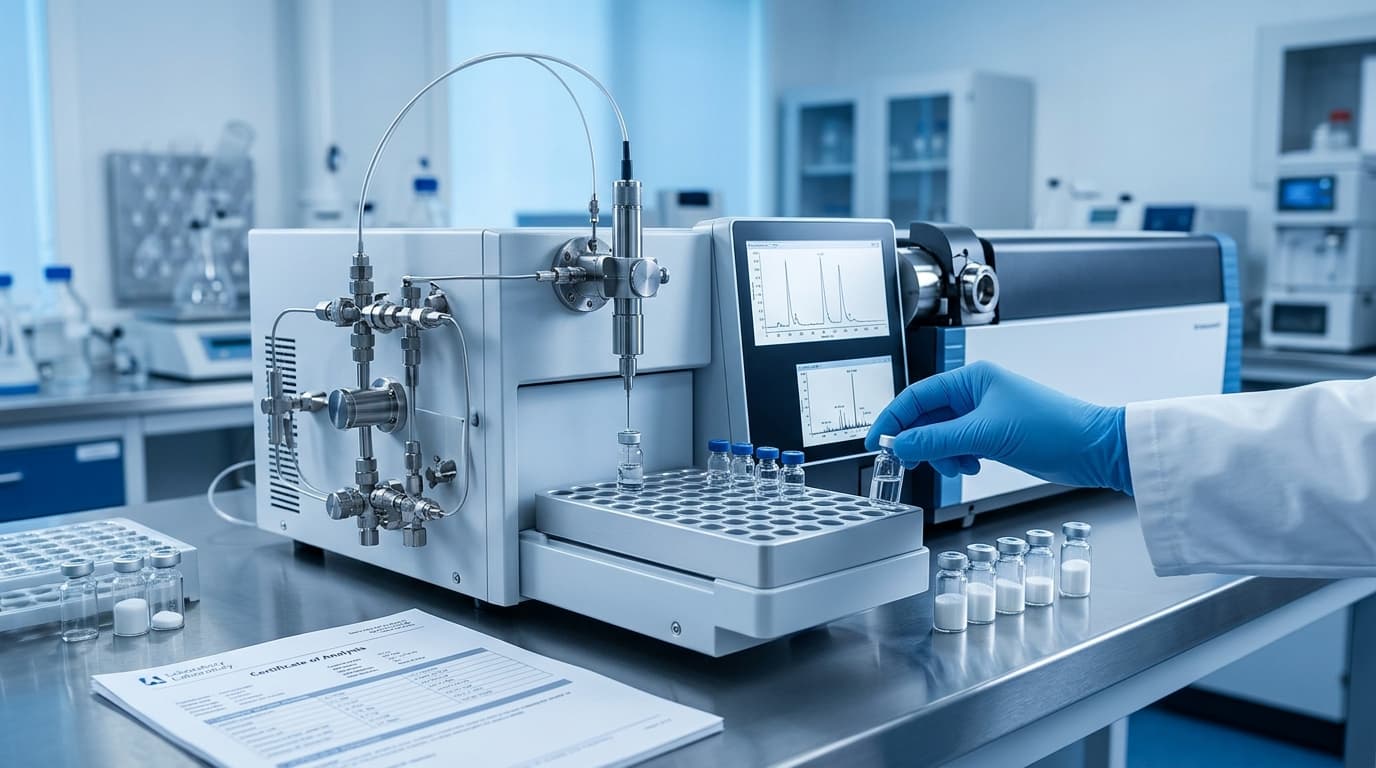
      A batch-specific Certificate of Analysis (COA) from an independent third-party US laboratory is the strongest proof of US-manufactured peptides. According to aminovault.com, proper US quality documentation must include:

      • HPLC chromatogram with purity percentage and peak identification
      • Mass spectrometry data confirming molecular identity (molecular weight match)
      • Endotoxin testing result (LAL assay, expressed in EU/mg)
      • Lot number matching the production batch on the vial label
      • Testing laboratory name and accreditation (ISO/IEC 17025 certification)
      • Date of analysis within 6 months of shipment

      Red Flags in COA Documentation

      Common deficiencies in imported or reseller products include:

      • Generic COAs not linked to specific lots: A single Certificate of Analysis recycled across multiple batches indicates the vendor has no batch-specific production data—a hallmark of resellers
      • HPLC purity only, without MS identity confirmation: Purity alone does not verify the compound is actually the target peptide; mass spectrometry confirms molecular weight and identity
      • Testing laboratories that cannot be independently verified: Check whether the issuing lab appears in public ISO 17025 accreditation databases maintained by accreditation bodies
      • No endotoxin data: Endotoxin testing via LAL assay is standard for research compounds; its absence suggests minimal quality oversight
      • COAs generated by the manufacturer's own QC lab: In-house testing creates conflicts of interest; third-party independent labs provide objective verification

      According to pspeptides.com, genuine US manufacturers post batch-specific COAs publicly without requiring login, account creation, or purchase—a transparency standard rare in the peptide industry because most vendors lack manufacturing data to disclose.

      Step 3: Verify Third-Party Testing Laboratory Accreditation

      US-based third-party analytical laboratories operating under ISO 17025 accreditation produce test results that can be cross-referenced against the issuing lab's accreditation status. Accreditation bodies maintain public databases of registered labs, allowing independent verification that a testing facility is legitimate and maintains current accreditation.

      According to americanpeptides.us, harmonized HPLC methodology produces comparable purity results across different laboratories—a feature that supports reproducibility across batches and across time. Overseas testing methodology is often internally developed and may not align with USP (United States Pharmacopeia) or ICH (International Council for Harmonisation) standards, which reduces cross-comparability of reported values.

      A qualified US-based vendor should confirm:

      • The name of the testing laboratory and its ISO 17025 accreditation number
      • That the laboratory operates independently from the peptide manufacturer
      • That testing includes validated HPLC methodology and LC-MS confirmation
      • Raw chromatogram data, not just summary percentages

      Step 4: Evaluate cGMP Compliance and Facility Documentation

      cGMP requirements cover four core areas that directly affect research peptide quality, according to pspeptides.com:

      1. Facility controls: Synthesis must occur in controlled environments with documented temperature, humidity, and contamination prevention measures
      2. Raw material qualification: Every reagent and amino acid used must be tested and documented before entering production
      3. Process validation: Synthesis and purification protocols must be validated to demonstrate consistent output across batches
      4. Batch records: Every production run must be fully documented, linking raw materials through synthesis, purification, lyophilization, and quality testing to the final vial

      Most peptide resellers cannot meet a single one of these requirements because they do not manufacture anything. They purchase finished peptides from contract synthesizers and repackage for retail. When a vendor claims cGMP compliance but cannot name a specific US facility or show batch-specific documentation, the claim is marketing language rather than manufacturing reality.

      A genuine US manufacturer should provide or confirm:

      • Facility certification documentation (FDA-aligned cGMP certification or equivalent)
      • Batch production records linking raw materials to finished vial
      • Environmental monitoring data for synthesis facilities
      • Change control procedures documented for any process modifications

      Step 5: Cross-Check Vendor Transparency and Support Infrastructure

      Top research peptide companies publish their testing standards and make COAs available before purchase, indicating confidence in their quality systems. According to biolongevitylabs.com, indicators of limited transparency include:

      • Reluctance to provide batch-specific documentation before or after purchase
      • Missing contact information for technical support
      • No published quality control procedures on product pages
      • Generic product descriptions without molecular weight, amino acid sequence, or synthesis method
      • Inability to answer questions about synthesis methods, purification protocols, or facility location
      • Vague return or replacement policies or no policy posted

      Researchers should verify that a vendor maintains:

      • Functional US-based customer support with reasonable response times
      • A clearly stated return and replacement policy
      • Standard payment options including credit and debit cards
      • Documented shipping methods and transit time commitments
      • A physical US business address (not a PO box or mail-forwarding service alone)

      Step 6: Request Multiple Independent Tests When Possible

      Multiple independent labs offer redundancy. If one facility reports 99.8% purity while another shows 97.2% for the same batch from the same vendor, a quality control problem exists before experiments begin.

      Minimum analytical methods for research peptides should include:

      • High-Performance Liquid Chromatography (HPLC) for purity quantification
      • Liquid Chromatography-Mass Spectrometry (LC-MS) for molecular weight confirmation
      • Sterility testing for microbiological contamination
      • Endotoxin screening via LAL assay
      • Heavy metal and chemical residue analysis when applicable

      Peptide quality control protocols should verify both identity and purity through orthogonal methods rather than relying on a single analytical technique.

      The Verification Standard for 2026

      Distinguishing genuine US-manufactured peptides from resellers requires systematic verification. A genuine US-made peptides manufacturer can name the synthesis facility by city and state, provide batch-specific COAs from independent testing labs, and verify the COA is dated within the last 12 months. A reseller cannot.

      This distinction separates reliable research compounds from compounds that only appear legitimate on a product page. By applying these six verification steps—facility location confirmation, COA specificity and origin, laboratory accreditation verification, cGMP documentation review, vendor transparency assessment, and redundant testing evaluation—researchers can make informed procurement decisions based on verifiable manufacturing data rather than marketing claims.

      Conclusion

      The US peptide market includes both genuine manufacturers and resellers. Distinguishing between them requires systematic verification of synthesis location, independent third-party testing documentation, and facility compliance records. Vendors unwilling or unable to provide specific, verifiable answers to these questions are resellers regardless of their "US-based" marketing language. Researchers investing time in verification protect both experimental validity and research integrity.

      Key takeaways:

      1. US-based company location differs fundamentally from US manufacturing location; verify synthesis facility by name, city, and state rather than accepting vague corporate claims.
      2. Batch-specific Certificates of Analysis from independent ISO 17025-accredited labs—with HPLC chromatograms, LC-MS data, and endotoxin testing—are the strongest proof of legitimate US manufacturing.
      3. Resellers cannot meet cGMP requirements because they purchase finished peptides overseas and repackage them; genuine manufacturers provide facility documentation, raw material qualification records, and full batch production logs.
      4. Red flags include generic COAs recycled across multiple batches, testing laboratories that cannot be independently verified, missing endotoxin data, and vague product descriptions without molecular specifications.
      Credit/Debit card processing now available! Enjoy 20% off (no minimum) until 8/31!CARD20