
US Peptide Science Research Team
August 23, 2026
Research into growth hormone secretagogue pathways frequently employs dual-pathway stimulation by combining CJC-1295 (Mod GRF 1-29, GHRH-receptor agonist) and ipamorelin (ghrelin/GHS-R receptor agonist). Both compounds engage complementary neuroendocrine signaling—GHRH-dependent and ghrelin-dependent—to produce additive or potentially synergistic effects on growth hormone release in experimental models.
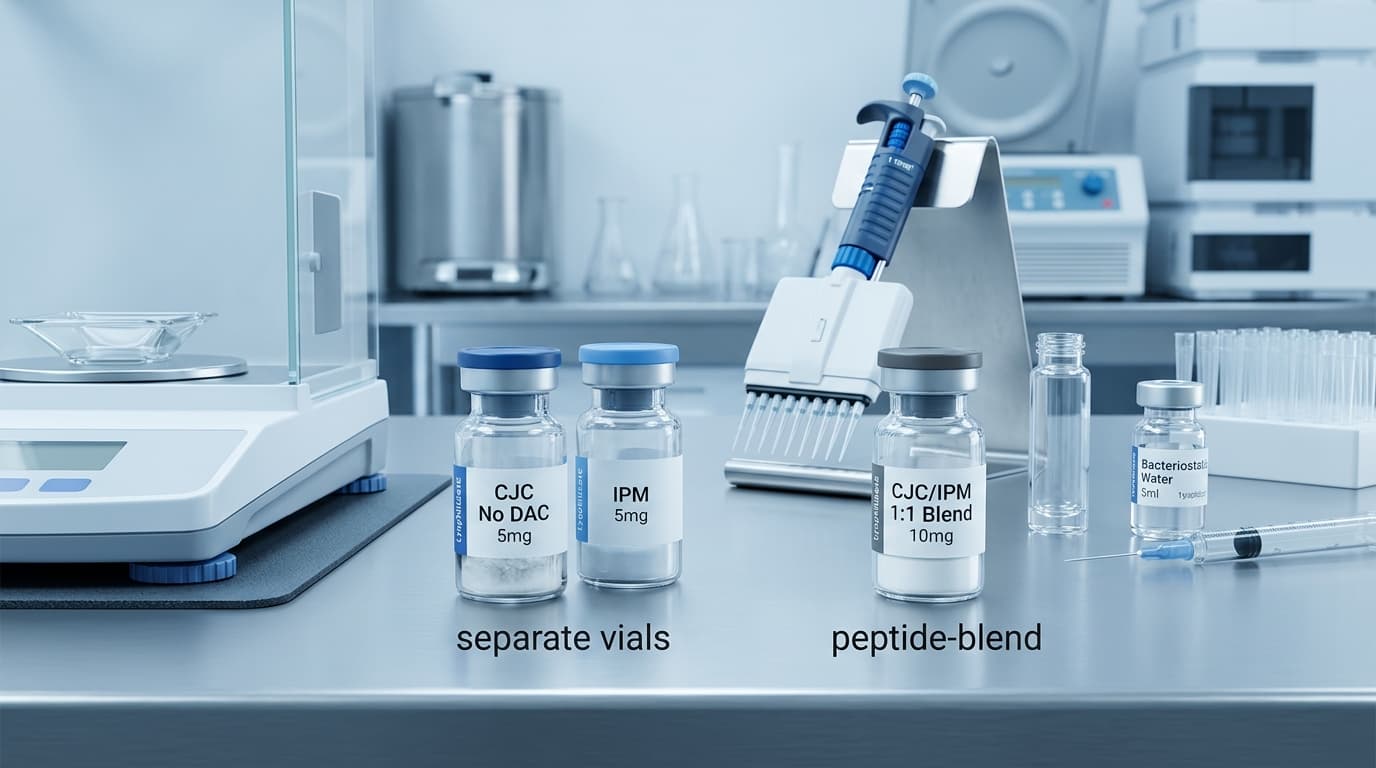
When sourcing these peptides, researchers encounter two purchasing formats: a co-lyophilized blend at fixed 1:1 ratio, or independent vials of each compound. The critical distinction is this: chemically, both formats are identical. The blend contains the same CJC-1295 No DAC and ipamorelin at the same purity standards as separate vials. The decision between them is not about compound quality or efficacy—it is about research protocol design, workflow efficiency, and analytical flexibility.
This article examines the evidence-based criteria for choosing between these formats.
Both the co-lyophilized blend and separately purchased CJC-1295 No DAC and ipamorelin employ the same manufacturing standards and quality gates. Research-grade peptide material is typically characterized by reversed-phase high-performance liquid chromatography (RP-HPLC) with UV detection near 214–220 nm, where the peptide bond absorbs. palmettopeptides.com reports that representative lots of the blend have been characterized at ≥98% purity by RP-HPLC, meeting the general research-grade benchmark.
For a blend, the chromatographic method must be validated to resolve both peptides and their potential degradation-related impurities independently. This means the reported purity figure reflects each compound's actual peak area, not a combined total. A rigorous Certificate of Analysis (CoA) will specify whether purity is reported per-peptide or as a combined main-component area—this distinction matters for experimental interpretation.
The single most important quality document is the lot-specific Certificate of Analysis. Generic specifications are insufficient; the CoA ties measured values—mass spectrometry identity, HPLC purity chromatogram, content, and physical description—to the specific lot in the vial. Investigators should retain the CoA for their records, cite the lot number in experimental documentation, and verify that the reported purity and identity match the material received, regardless of whether the source is a blend or separate vials.
The most immediate operational difference lies in preparation complexity.
Blend Reconstitution: Because the CJC-1295 No DAC and ipamorelin are co-lyophilized, both compounds dissolve together in a single reconstitution step. The resulting solution carries equal mg/mL concentrations of each peptide (since the vial contains equal masses at 1:1 ratio). Reconstituting a 5mg/5mg vial with 2 mL of bacteriostatic water yields 2.5 mg/mL of CJC-1295 No DAC and 2.5 mg/mL of ipamorelin simultaneously. One vial of bacteriostatic water, one reconstitution session, one concentration calculation.
Separate Vials Reconstitution: Each vial is reconstituted independently using standard single-compound calculations. A researcher must prepare two separate solutions, each with its own bacteriostatic water volume, concentration derivation, and labeling. While two vials of bacteriostatic water may be used, a single multi-dose vial of bacteriostatic water can typically serve both reconstitutions if aseptic technique is maintained.
For protocols involving dozens of administrations over multiple weeks, this difference compounds: the blend requires one reconstitution session per vial lifetime; separate vials require two. The time savings are modest per dose but accumulate across a full protocol.
The blend delivers both compounds in a single draw at the fixed 1:1 ratio. Separate vials permit greater flexibility:
For most single-protocol research designs running a standard 1:1 stack on synchronized schedules, the blend's single-draw simplicity is well suited. Research designs requiring variable-ratio, split-timing, or isolated single-compound control phases require separate vials.
The blend is fixed at 1:1 by weight. If a research design explores whether different ipamorelin-to-CJC-1295 No DAC ratios produce different growth hormone kinetics in experimental models, the blend cannot accommodate this. Separate vials allow any ratio a protocol specifies.
Similarly, if a protocol requires CJC-1295-only or ipamorelin-only control arms to isolate each compound's contribution, separate vials enable this directly. With a blend, researchers cannot easily separate the two compounds once co-lyophilized at 1:1 ratio.
palmettopeptides.com notes that separate vials support "CJC-1295-only controls, Ipamorelin-only controls, independent identity testing, separate stability analysis, flexible concentration-response investigation, alternative component ratios, and direct testing for additive or synergistic activity." These are research-design questions that separate vials answer; a blend does not.
The blend uses CJC-1295 No DAC (Mod GRF 1-29) exclusively. This is the short-acting GHRH analog.
The alternative, CJC-1295 with DAC (Drug Affinity Complex—albumin-binding modification), is long-acting. If a research protocol specifies the DAC variant, the blend cannot substitute for it. Separate vials allow researchers to source CJC-1295 DAC if their protocol requires it, pairing it with ipamorelin at whatever ratio the study design calls for.
This is a critical constraint: if a protocol mandates CJC-1295 DAC, separate vials are required.
palmettopeptides.com reports that the blend and separately purchased CJC-1295 No DAC and ipamorelin are priced comparably when equivalent total peptide mass is purchased. Total peptide mass for an equivalent dose is the same either way.
The primary operational consideration is reconstitution efficiency: one vial of bacteriostatic water and one reconstitution session serves both compounds in the blend, versus two separate reconstitution sessions for separate vials. Across a multi-week protocol, this translates to modest material savings (one fewer vial of bacteriostatic water, one fewer labeling session) and reduced bench time.
From an inventory perspective, the blend requires one SKU and one lot number; separate vials require two. For labs managing multiple protocols or long-term stock, separate vials offer greater modularity—if one compound is depleted, the other remains available for other studies.
Regardless of format, rigorous quality assurance is non-negotiable. Both blend and separate vials should ship with lot-specific Certificates of Analysis documenting:
Investigators should retain the CoA for their records, cite the lot number in experimental documentation, and verify that the reported purity and identity match the material received. For a blend, the CoA should clarify whether purity is reported per-peptide or as a combined main-component area. This distinction affects how results are interpreted relative to literature values for single-compound studies.
The blend is appropriate for research protocols that:
Separate vials are necessary for research protocols that:
The choice between co-lyophilized blend and separate vials is not a choice between different compounds or different quality standards. Both formats deliver CJC-1295 No DAC and ipamorelin at equivalent purity and potency. The decision is about research protocol design: whether a study's ratio, timing, variant selection, and control-arm requirements fit the blend's fixed 1:1, synchronized-dosing architecture, or whether the protocol's flexibility demands the modularity of separate vials.
For standard dual-pathway research following established 1:1 protocols, the blend offers operational simplicity. For studies exploring ratio variability, DAC substitution, independent timing, or isolated compound effects, separate vials are required. The core decision rule is simple: if the ratio is a fixed input to the study, the blend removes bench-work overhead with no scientific trade-off. If the ratio is a variable being studied, or needs to be adjustable at all, separate vials are necessary.
In either case, retain lot-specific Certificates of Analysis, verify purity and identity before use, and document the lot number in experimental records. Quality assurance is the constant; format is the variable.